Maonyesho
Sponsorship and Visibility
Loise Nyokabi · Sep 14, 2026
Where Visibility Actually Comes From: A Sponsorship and Visibility Guide
Every year, brands set aside a sponsorship or activation budget, and every year, a good portion of it goes toward placements that look good on a report but don't actually change how many of the right people saw the brand, remembered it, or acted on it. That gap between spend and visibility isn't usually a budget problem. It's a selection problem.
This is a practical guide to closing that gap: how to think about sponsorship before you commit to one, what actually drives visibility versus what just feels like it should and how to evaluate an opportunity properly once you're looking at a real proposal.
Start with audience overlap, not audience size
The most common mistake in sponsorship decisions is chasing the biggest possible audience instead of the most relevant one. A sponsorship in front of 50,000 people who have no reason to buy your product is worth less than one in front of 5,000 people who are already close to a buying decision in your category. Before anything else, ask how much of the audience actually overlaps with the people you're trying to reach.
Formats matter as much as placement
Not all sponsorship inventory carries the same weight. A logo on a banner is passive. A branded activation that someone interacts with, a speaking slot, or a themed zone that puts your brand inside the actual experience rather than around the edges of it, tends to carry far more. When you're reviewing a proposal, look past the headline sponsorship fee and ask specifically what format your brand will actually take: static branding, an activation, a stage moment, or a dedicated space.
Understand the partner tiers you're being offered
Well-structured events usually build their sponsorship offering in tiers, and it's worth knowing where a given package sits before you commit:
Exclusive naming partner — the highest-visibility tier, typically one per zone or category, with naming rights and top-of-mind association.
Supporting corporate partners — a small number of additional brands sharing visibility within the same space.
Institutional or development partner — usually reserved for a government body, NGO, or development agency whose involvement lends credibility rather than commercial reach.
Product or service partners — brands contributing approved value-in-kind support in exchange for smaller, more targeted visibility.
Knowing which tier you're being pitched changes what a fair price looks like, and what you should reasonably expect in return.
A case in point
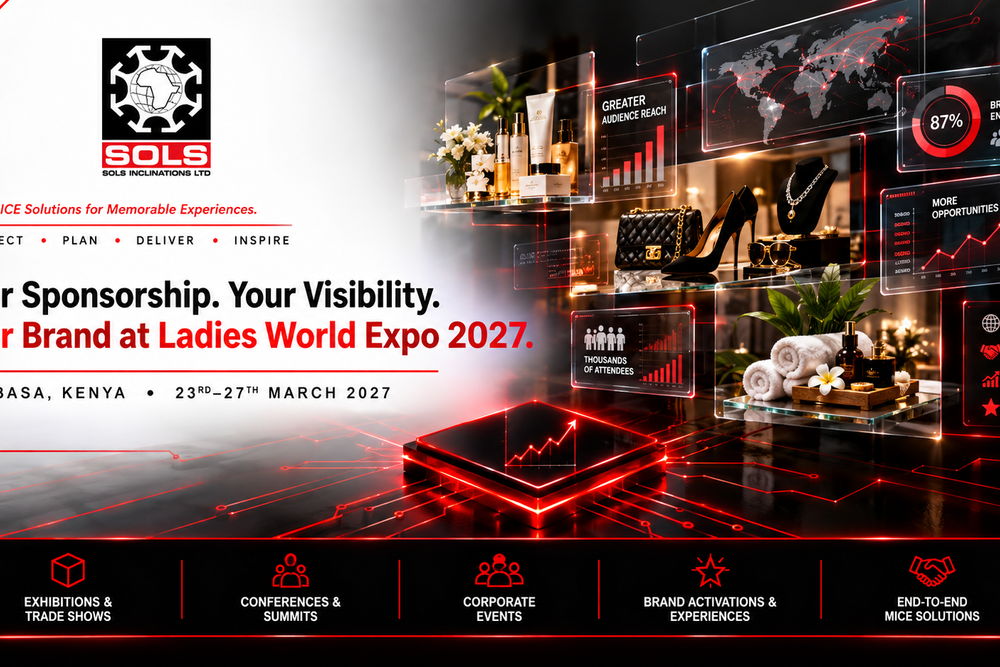
To make this concrete, it helps to look at a real proposal structure. EEO's forthcoming Ladies World Expo, running 23–27 March 2027 at Sun N Sand Beach Resort in Mombasa, is a useful example because its sponsorship offering is built almost exactly along the lines described above.
The event is organised into 12 themed pavilions, each open to one exclusive naming partner, two supporting corporate partners, one institutional or development partner, and a small number of product or service partners. A Pavilion Partnership includes naming rights, branding at the pavilion entrance, a premium 3m by 6m exhibition space, a speaking opportunity, a branded activation, and a set of delegate passes, priced as a single package rather than a menu of add-ons.
That pricing spread is itself a visibility signal. A low-cost Day Pass and mid-tier 4-Day Pass bring in broad, general-public foot traffic across the week, the VIP tier tends to attract more engaged, higher-intent attendees, and a free Virtual Pass extends reach to people who won't be at the venue at all. A sponsor evaluating this kind of structure gets a fairly accurate read on the mix of audiences they'd actually be visible to, before committing anything.
Where sponsors typically fit
Pavilion sponsorship — align with the themed zone that matches your category
Runway or stage branding — visibility during moments where attention is already concentrated
Live zone activations — a hands-on brand presence rather than a static stand
General exhibitor presence — a straightforward stand within the exhibition floor
What to ask before you commit, to any sponsorship
Regardless of the event, before signing off on a sponsorship budget, it's worth asking the organiser directly for the specific inclusions attached to a package, how the audience for that particular zone or format is expected to break down, and what reporting or performance summary you'll receive afterward. We won't hand you a projected reach number we can't verify, here or anywhere else, but a credible organiser should be able to walk you through exactly what's on offer.